In the world of Magic: The Gathering, it’s very common to call that special card in our collection a “relic.”
It might be a card that marked our childhood, the first expensive card we ever bought, or simply a piece we’re deeply attached to.
And there’s nothing wrong with that.
But there’s an important difference between “my relic” and “a true relic” within the Magic collecting market.
That difference is exactly what gave birth to the Relics Score, an evaluation framework created to help collectors better understand what they own — and, above all, what they’re buying.
How did the Relics Score come about?
Before creating the tool, I noticed that many people confused what was a personal relic with what could actually be considered a relic within high-end collecting.
So I started by trying to explain that difference through content.
I created a trend on social media and tagged several influencers so they would also show their own relics.
The idea was precisely to make as many people as possible aware of that difference.
But a second question quickly came up:
How can collectors learn to analyze a card on their own?
That’s where the need for a tool came from.
A framework that would help anyone look at a card and reach a more structured conclusion:
is it a relic, a collection piece, or a trap?
What turns a Magic card into a relic?
A card doesn’t become a relic simply because it’s expensive.
Being beautiful isn’t enough either.
And not even rarity is sufficient.
To me, a true relic needs to combine characteristics like scarcity, demand, liquidity, historical relevance, and market recognition.
The market needs to confirm that the card truly holds a prominent position within high-end collecting.
That’s the idea behind the five criteria of the Relics Score.
Each one receives a score from 0 to 2 points, for a final evaluation of up to 10 points.
The five criteria of the Relics Score
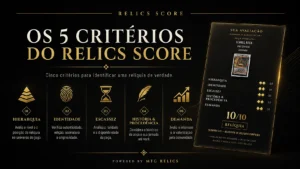
1. Hierarchy
Is there a clearly superior version of this card?
One of the first things a collector needs to understand is that the same card can have dozens of versions.
Foil, borderless, showcase, promo, Judge, Masterpiece, original edition, older printings, printings in other languages, and many other possibilities.
Hierarchy tries to understand where that printing sits within this universe.
If there’s a clearly more desired, rarer, or more important version, that naturally affects the weight of the piece.
2. Identity
Does it have something visual that makes it unforgettable?
A true collection piece usually has an identity of its own.
It can be an iconic artwork, a specific treatment, a historic frame, or some visual characteristic instantly recognizable by collectors.
But visual identity alone doesn’t make a relic.
That’s exactly one of the points where many buyers get confused.
3. Scarcity
Does supply truly limit access?
Being different doesn’t necessarily mean being rare.
For the Relics Score, what matters is understanding whether there’s a real supply limitation.
The harder it is to put new copies of that version on the market, the stronger it tends to be as a collectible piece.
And here’s another important distinction:
rarity without demand is still just rarity.
4. History & Provenance
Does the card’s history — or that specific copy’s provenance — add real relevance?
Some cards carry a weight that goes far beyond the printing itself.
It can be a historically relevant edition, an emblematic printing within Magic, or even a specific copy with special provenance.
This also includes artist-signed pieces, altered cards, Artist Proofs with sketches, or copies carrying some intervention, dedication, or story capable of making that copy unique or especially desirable to collectors.
But these characteristics don’t generate value automatically. The point is understanding whether that signature, alteration, sketch, or provenance truly adds relevance, exclusivity, or history to the piece.
This context helps separate merely expensive cards from objects that carry real weight within collecting.
5. Demand
Is there real demand and a market capable of sustaining this piece?
This is one of the most important criteria in the Relics Score.
A card can be extremely rare, beautiful, and expensive.
But if practically no one is interested in buying it, it’s much closer to a collection piece than to a true relic.
A relic needs to be recognized by the market.
A huge listing price means nothing if there’s no buyer willing to pay it.
Trap, collection piece, or relic?
After evaluating the five criteria, the Relics Score arrives at three possible classifications.
Trap: 0 to 4 points
The name may sound harsh, but there’s a very important distinction:
a trap is not necessarily a bad purchase.
A card can receive this classification and still be exactly what a given collector wants.
Maybe they love that artwork.
Maybe they want to complete a themed deck.
Maybe there’s an emotional connection to that version.
All of that is valid.
The problem starts when someone buys a card believing they’re acquiring a great high-end piece when, by the criteria used, it doesn’t have those characteristics.
The Relics Score doesn’t try to stop anyone from buying.
It tries to stop people from buying wrong.
Collection Piece: 5 points or more
Here we find cards with characteristics that matter to collectors, but that still don’t reach all the elements needed to be considered true relics.
They can be rare, beautiful, historic, or special.
And they can absolutely hold an important place in a collection.
Relic: 8 to 10 points, with maximum Demand
To reach the Relic classification, simply adding up points isn’t enough.
The card also needs to receive the maximum score in the Demand criterion.
This lock exists for a simple reason:
a relic needs to be recognized by the market.
If there are no buyers, no liquidity, and no demand sustaining that piece, it makes no sense to classify it the same way as a card truly desired by the high-end market.
An expensive card is not the same as a relic
This may be one of the most important concepts in the entire Relics Score.
Price alone says much less than it seems.
A card can cost thousands of dollars and still not be a relic.
Likewise, certain cards that look simple can carry enormous relevance in collecting.
Many Old Frame Foils, Reserved List cards, and even certain basic lands can be true relics.
Meanwhile, many extremely flashy modern cards may not pass the same test.
There are VIPs, Mystical Archives, borderless printings, and countless versions with incredible visual treatments that immediately look like high-end pieces.
Some really are.
Others are just pretty cards.
The biggest mistake of high-end Magic beginners
In my opinion, one of the most common mistakes among people starting out in high-end is simple:
buying a card just because it’s beautiful.
Magic is living through an era with an enormous amount of special treatments.
Showcase.
Borderless.
Different foils.
Alternate arts.
Secret Lairs.
Promotional versions.
All of this greatly increases the options available to collectors.
The problem is that a special visual treatment can create a feeling of exclusivity without real scarcity or strong demand actually existing for that version.
Beauty can create desire.
But beauty alone doesn’t turn a card into a relic.
The Relics Score is not there to tell you what to like
This may be one of the most important interpretations of the tool.
The goal of the Relics Score is not to turn collecting into math.
Much less to say you should only like the cards with the highest scores.
Collecting remains something deeply personal.
The tool’s role is different:
helping you understand exactly what you’re buying.
If you want to buy a card classified as a trap because you find its artwork wonderful, perfect.
If you want a collection piece because it fits your deck, that’s fine too.
The problem is buying a card thinking you’re getting a great market relic when, in practice, it doesn’t have the elements for that.
When there’s information, the decision becomes a conscious one.
A tool for learning to choose Magic card versions
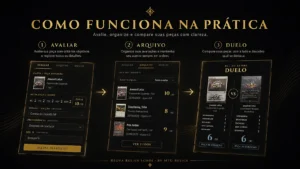
The main goal of the Relics Score is educational.
It wasn’t created to simply spit out a score.
What matters most is making collectors understand why that score appeared.
By repeatedly evaluating the five criteria — Hierarchy, Identity, Scarcity, History & Provenance, and Demand — collectors naturally start to see the different versions of cards in a new way.
Over time, the question stops being just:
“Is this card beautiful?”
And becomes:
“Is there a better version?”
“Is this printing really scarce?”
“Is there demand for it?”
“Does the market recognize this version?”
“Does it have historical relevance?”
This kind of reasoning can completely change how a collection is built.
Fewer cards, better choices
Those looking to build a truly distinctive collection start seeing cards with different eyes.
Instead of simply accumulating premium versions, they begin to better understand each one’s position within the market.
That may mean choosing fewer cards.
But choosing better.
It can also help when deciding which version to buy, which to keep, and even which to sell.
The point is not to tell collectors what to do.
It’s to give them more information so they can make those decisions consciously.
Is the Relics Score an absolute truth?
No.
In life, almost nothing is definitive.
The Relics Score is a framework I created based on my experience, my observation of the high-end market, and the elements I consider most important for identifying a relic.
But it can evolve.
Community feedback, market changes, and real cases that challenge the current logic can lead to future adjustments.
A good evaluation tool needs to be able to evolve alongside the very market it aims to analyze.
The Relics Score was born in Brazil — but the criteria are universal
The project was born in Brazil, but the criteria don’t depend on the Brazilian market.
Collectors everywhere face exactly the same doubts when trying to tell versions apart, understand scarcity, and evaluate the strength of a piece within the market.
That’s why the Relics Score is available in English — and also in Portuguese.
The idea is that the same methodology can be used by collectors regardless of country.
So, what is the Relics Score for?
In one sentence:
the Relics Score is for evaluating a card and understanding whether it’s a relic, a collection piece, or a trap.
But there’s a bigger goal behind it.
I want everyone who uses the tool to better understand the differences between the countless versions of Magic cards.
To make better decisions about what to buy.
What to keep.
And also what to sell.
At the end of the day, collecting better doesn’t necessarily mean spending more money.
It means better understanding what you’re putting into your collection.
Put your cards to the test: evaluate any card in your collection right now with the Relics Score, available in English and Portuguese.
And if one of your pieces reaches the Relic classification, tag @mtgrelics on Instagram and show the score. I want to see which relics are out there.
Frequently asked questions about the Relics Score
What is the Relics Score?
It’s an evaluation framework that analyzes Magic: The Gathering cards across five criteria — Hierarchy, Identity, Scarcity, History & Provenance, and Demand — and classifies each piece as a relic, a collection piece, or a trap. The tool is available at mtgrelics.com.
Is every expensive Magic card a relic?
No. A high price alone doesn’t guarantee real scarcity or sustained market demand. A card can cost thousands of dollars and still not combine the elements that high-end collecting recognizes in a true relic.
Are artist-signed Magic cards worth more?
It depends. Signatures, alterations, dedications, and Artist Proofs fall under the History & Provenance criterion, but they don’t generate value automatically: what matters is whether that intervention truly adds relevance, exclusivity, or history to the piece.
What’s the difference between a collection piece and a relic?
A collection piece is a card that scores 5 points or more and has characteristics that matter to collectors. A relic requires 8 to 10 points with a maximum score in Demand — that is, real market recognition, with buyers and liquidity sustaining the piece.
Is the Relics Score tied to the Brazilian market?
No. The project was born in Brazil, but the criteria are universal and don’t depend on any local market. The tool is available in English and in Portuguese.