Gaboleps has illustrated more than 100 Magic: The Gathering cards. But when I asked him which one he’d consider his own relic, the answer had nothing to do with price, rarity or market value.
The card he chose was Faceless One.
And his explanation says a lot about what can turn a Magic card into something bigger than a game piece or a valuable item.
Who is Gaboleps?
Gaboleps is a Brazilian artist who works with Magic: The Gathering and has had his art printed on well over a hundred cards.
His work has a recognizable style, but during our conversation it became clear that, for him, what matters about an illustration goes far beyond the visual result.
There’s an entire process of turning feelings and ideas into something other people can see — and, eventually, feel too.
That’s exactly what came up when I asked which of his own cards he considered a relic.
Faceless One: the relic Gaboleps chose
Out of every card he has illustrated across his career, Gaboleps picked Faceless One.
What makes it interesting is that the choice didn’t come from analyzing which card is worth the most money, or which one collectors chase hardest.
It came from the artist’s relationship with his own creation.
Card details
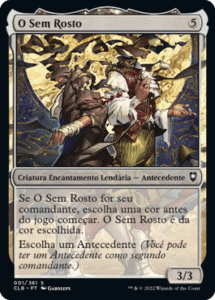
- Card: Faceless One
- Set: Commander Legends: Battle for Baldur’s Gate (CLB) — card #1
- Type: Legendary Enchantment Creature — Background
- Cost: 5 · P/T: 3/3 · Rarity: Common
- Illustration: Gaboleps
Notice the detail: the artist’s personal relic is a common card. And still, it’s number 1 in the set.
During our conversation, Gaboleps explained how an emotion can first turn into language, and how that language then gets converted into an image.
It’s almost a path:
emotion → language → image → emotion again.
The artist feels something, tries to express it visually, and hands the work over to the world. On the other side, someone looks at that image, interprets it, and feels something from it.
When that connection happens, the cycle closes.
The real value of art in Magic: The Gathering
Anyone who follows the Magic market is used to judging cards by criteria like rarity, scarcity, demand and price.
And those factors matter enormously when we’re talking about collecting and market value.
But there’s another layer.
A Magic card is also a small work of art.
Inside that piece of cardboard is the work of an artist who received a concept, interpreted an idea, and had to turn it into an image capable of making sense inside a universe millions of players already know.
When we hear the illustrator himself explain the process behind the piece, we start seeing the card differently.
It stops being only:
“How much is this card worth?”
And starts raising another question too:
“What does this art mean?”
A relic doesn’t always have to be the most expensive card
At MTG Relics, I like to separate two ideas.
There’s what we might call a relic recognized by the market: a card whose combination of scarcity, demand and market strength gives it a special place in collecting — the way Reserved List cards do.
But there’s also my relic.
That one is personal.
It can be an extremely expensive card, an Artist Proof, a signed card, a one-of-a-kind piece, or even a card with almost no financial value at all.
What matters is the meaning it carries for that person.
Gaboleps choosing Faceless One is a perfect example of that second category.
Among more than 100 illustrations, there’s one piece carrying a special meaning for the person who created it.
And no amount of money fully explains that.
Why knowing the artists changes how you collect Magic
The more contact I have with Magic artists, the more I realize that knowing the story behind the cards completely changes the experience of collecting.
A signature stops being just ink on a card.
An Artist Proof stops being just a rare version with a white back.
And an illustration you’ve seen dozens of times can take on a whole new meaning after hearing directly from the artist what was behind it.
Maybe that’s exactly what makes collecting so interesting.
We don’t collect objects alone.
We collect stories, moments, artists, experiences and emotions.
What’s your relic?
The conversation with Gaboleps reinforced something I believe more and more:
not every relic has to be defined by price.
The market can tell you which cards are rare, wanted or extremely valuable.
But some of the most important pieces in a collection can only be explained by their owner.
And maybe that’s exactly what makes them true relics.
Now I want to know: which Magic card do you consider your relic — the one you wouldn’t sell for any amount of money?
MTG Relics explores the world of high-end Magic: The Gathering cards, signed cards, Artist Proofs, Reserved List, art, authenticity, and the stories that turn a card into a true relic.