Filipe Pagliuso illustrates official Magic: The Gathering cards, but he has never been a Magic player. Even so, he was given an assignment that any longtime fan would immediately recognize as special: creating a new artwork for Dark Ritual, one of the most iconic cards in Magic history.
In a conversation with MTG Relics, while signing a playmat, the Brazilian artist talked about how he only discovered the importance of Dark Ritual after receiving the commission, the difference between working on traditional Magic sets and Universes Beyond, and a lesser-known side of the production process: artwork that Wizards of the Coast commissions, pays for, and sometimes never releases.
Below are some of the highlights from the interview, with minor edits to the quotes for readability.
What Is Filipe Pagliuso’s Relic?
At MTG Relics, we call a piece a “relic” when it stands out in areas such as hierarchy, identity, scarcity, history, and demand — criteria that are part of the Relics Score.
So we asked what sounded like a simple question: of all the cards he has illustrated, which one would be his relic?
The answer wasn’t so simple.
“Wow, that’s difficult, because I think I have several relics in that sense.”
Among the cards on the table during the interview, Pagliuso chose Tome Blast as his favorite at that moment.
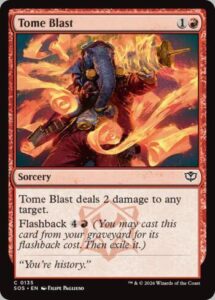
Tome Blast, illustrated by Filipe Pagliuso.
The choice makes sense. For an artist who continues to create new work for Magic, today’s favorite may change with the next commission. But at that moment, Tome Blast was the card he singled out.
Creating a New Dark Ritual Artwork Without Being a Magic Player
Dark Ritual has been part of Magic since Alpha in 1993. For a single black mana, the card generates three black mana and has become one of the most recognizable examples of mana acceleration in the game’s history.
The original artwork by Sandra Everingham is part of the visual memory of generations of Magic players. Creating a new interpretation of such a historic card therefore comes with a certain amount of weight.
Pagliuso, however, only truly understood the importance of Dark Ritual after receiving the commission.
“I’m not a player, you know? So I actually got to know the card when I was asked to create the new version.”
A close friend of his, who plays Magic regularly, was the one who explained just how important the card was.
“I told him, ‘Man, I’m doing a new interpretation of this card I saw called Dark Ritual.’ And he said, ‘Wow, that card is a real classic.'”
That same friend showed him the original artwork. His reaction was immediate:
“Wow, man. What a crazy card.”
The new illustration ultimately went in its own direction rather than trying to directly reproduce the original artwork.
Still, learning that he was reinterpreting such an important piece of Magic history changed the experience for him.
“For me, it was really cool. I loved the process.”
For collectors, that’s precisely one of the fascinating things about cards like Dark Ritual: the same card can span completely different eras of Magic through its artwork.
You can compare the different versions of Dark Ritual on Scryfall.
And just as language and edition can influence which printing a collector chooses, artwork can play a major role in deciding which version belongs in a collection.
Traditional Magic Sets vs. Universes Beyond: Where Does the Artist Have More Freedom?
We also asked about the difference between illustrating for Magic’s own universe and working on Universes Beyond products based on established franchises.
According to Pagliuso, traditional Magic sets usually allow for much more creative freedom.
In many cases, Wizards provides the essential elements of the brief and gives the artist room to develop the rest.
“Let’s say it’s an elephant creature and it has to wear something roughly like this. The rest is up to you, you know?”
With Universes Beyond, things are different.
When working with properties such as Marvel or other established franchises, the characters already have a well-defined visual identity, which naturally leaves less room for reinvention.
That’s one reason Pagliuso especially enjoys working on sorceries and instants.
With those cards, the illustration can be driven more by action, narrative, and atmosphere rather than having to strictly follow an established character design.
The Artwork Wizards Pays For but Never Uses
Perhaps the most surprising part of the interview came when we asked what happens when an illustration is created for a card that may ultimately never be released.
Pagliuso has experienced this himself.
“On the Doctor Who set, for example, I made three pieces and one of them didn’t make it.”
According to the artist, this can happen when a card changes during the development of a set. A mechanic may be revised, the card may be removed, and the artwork is no longer needed.
It has happened to him twice.
One of those cases had an even more unusual twist.
One of the cards he brought to the interview actually used the second version of an artwork created for the same card.
“I made the artwork, I got paid, and a month later I received an email saying, ‘Remember that artwork? We’re not going to use it. We’re going to commission another one.'”
At that point, it would simply have been an unused piece of artwork.
But there was one interesting detail: the replacement commission was also given to him.
The result? Two completed illustrations, two paid commissions, and only the second artwork making it onto the final printed card.
For players and collectors, this side of Magic’s production process is almost completely invisible.
But it shows how much can happen between the initial concept and the card that ultimately reaches a booster pack: revisions, changes, and entire finished pieces of artwork that the public may never see.
What Does an Artist Signature Change for a Collector?
Our conversation began while Pagliuso was signing a playmat.
For the artist, it may be a quick gesture. For the collector, it can become the beginning of a new story connected to that piece.
The same applies to cards.
A signature obtained in person creates a direct connection between the item and the artist while also helping document its provenance.
That does not automatically mean the card becomes more valuable.
The impact of a signature depends on the card, the artist, demand, and the type of collector interested in the piece.
In some cases, a signature can add value. In others, it can reduce liquidity.
We explore this subject in more detail in our article about whether signed Magic cards are worth more.
There are also more personalized forms of artist work.
An Artist Proof can receive an original sketch on its blank back, while an altered Magic card can feature artwork painted directly onto the card itself.
Each of these has a different impact on collectibility, value, and liquidity.
Whenever possible, it is also worth documenting when and where a card was signed. Photos, videos, dates, and event information can help preserve the provenance of the piece.
The Artist Behind the Card
Talking with Filipe Pagliuso is a reminder that there is much more behind a Magic card than what we see on the game table.
Before a card reaches a deck, binder, or collection, someone received a brief, imagined a scene, made visual decisions, and helped turn an idea into an image.
Sometimes, as happened with Dark Ritual, even the artist only discovers later just how much history is attached to the card he was asked to illustrate.
And sometimes an entire piece of artwork can be finished, approved for payment, and still never be seen by players.
For those who collect Magic not only as a game but also as art and history, these behind-the-scenes stories are part of what makes each piece even more interesting.
More MTG Relics Interviews and Content
This conversation is part of the MTG Relics interview series with artists connected to Magic: The Gathering.
Continue exploring:
- Interview with Caio Monteiro
- Watch the full video interview on the MTG Relics YouTube channel
- Evaluate your cards with the Relics Score
Frequently Asked Questions
Who is Filipe Pagliuso?
Filipe Pagliuso is a Brazilian artist who illustrates official Magic: The Gathering cards. His work includes a new artwork for Dark Ritual, as well as illustrations created for Universes Beyond products.
Who created the original Dark Ritual artwork?
The original Dark Ritual artwork, released in Alpha in 1993, was created by Sandra Everingham. The card has since received many different visual interpretations.
Does a Magic artist need to play Magic?
No. Filipe Pagliuso told MTG Relics that he is not a Magic player and only learned more about the importance of Dark Ritual after receiving the commission to create a new artwork for the card.
Can Wizards decide not to use artwork it has already commissioned?
Yes. According to Pagliuso, changes during set development can cause a card to be modified or removed even after its artwork has already been completed.
Are artist-signed Magic cards worth more?
It depends. A signature can add provenance and collector appeal, but its impact on value varies depending on the card, the artist, and market demand.
Follow MTG Relics on Instagram
Want to see more artist interviews, signed cards, and high-end Magic collectibles?
Follow @mtgrelics on Instagram. Every week, we share content about collecting, authenticity, card evaluation, and behind-the-scenes stories from Magic events.
What would you ask the next Magic artist we interview?
Send us a DM at @mtgrelics — your question might appear in the next interview.